


When BMW Group announced software development updates for Plant Landshut on July 21, one detail stood out: engineers are on the factory floor wearing motion capture suits and data gloves to train humanoid robots via human demonstration. Much like our approach at FMC³, seeing physical AI trained via human demonstration inside BMW’s largest component plant signals a decisive industry shift.
Get to know more about our products: https://www.fmc3-robotics.ai/Products
The data question
Language models trained on internet text achieved their capabilities because trillions of tokens were already available. Autonomous driving built its datasets from billions of miles of road testing. Robotics has neither of these luxuries. The data a robot needs to learn a manipulation task — synchronized video, joint positions, motor torques, tactile feedback, force readings — does not exist anywhere in usable form. It has to be captured, one demonstration at a time, in physical environments.
The scale of this data gap is well documented. According to recent industry analyses on embodied AI infrastructure, current short-term demand for high-quality manipulation data has reached roughly 1.2 million hours, while total global production capacity remains constrained at 250,000 to 300,000 hours per month. Building a truly generalizable physical AI model may ultimately require upwards of 10 million hours of multimodal real-world interaction, yet the existing global pool of mature, structured datasets sits at only a few hundred thousand hours.
Why human-centric data is the core part
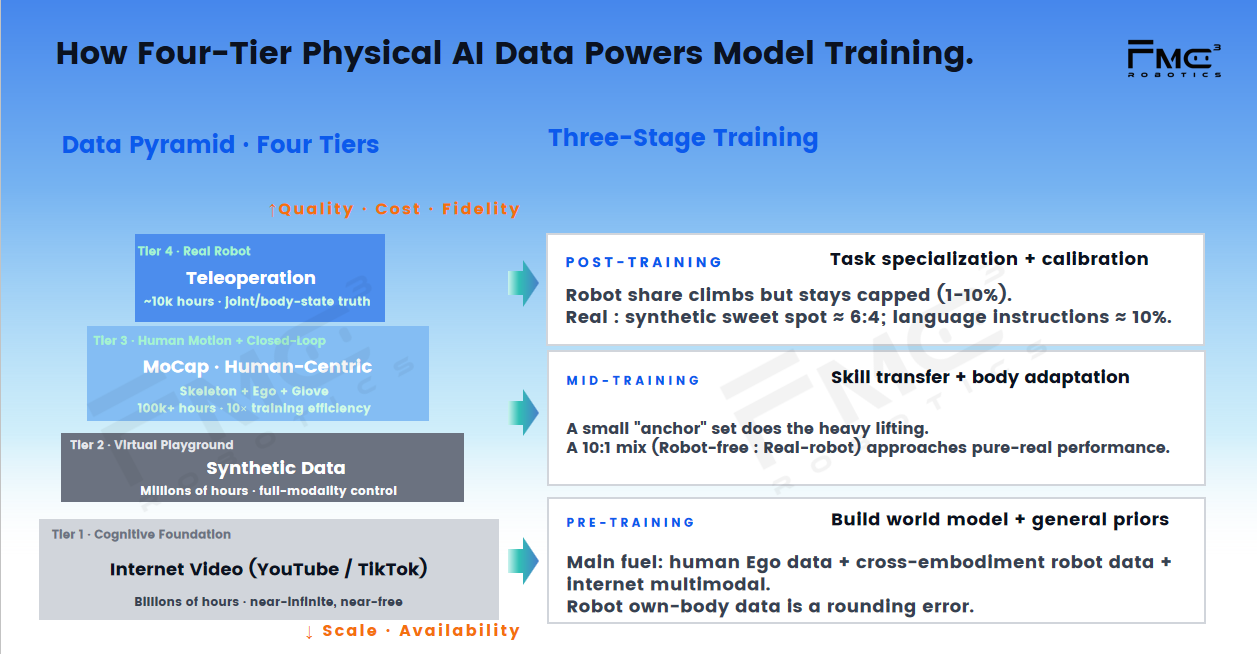
There are four main approaches to generating embodied AI training data, each with well-understood trade-offs.
Internet video is abundant but lacks the physical metadata robots need: no joint torques, no tactile readings, no end-effector positions. It can teach a robot what folding laundry looks like, but not how to do it.
Simulation is nearly free and scales easily, but the sim-to-real gap remains unresolved, particularly for tasks involving contact, deformation, or friction. Synthetic data alone cannot complete the training pipeline.
Teleoperation produces the highest-fidelity data, but a 30-second clip costs roughly €1.50–€2.00, and one hour runs about €130. Reaching 200,000 hours would require over €25 million in collection costs alone. It is expensive and hardware-specific.
That richer layer is what we call human-centric data.
Humans perform real tasks in real environments, wearing equipment that records ego-view video, twenty-two-degree-of-freedom hand tracking, tactile sensors, and force readings — all synchronized with sub-twenty-millisecond timing. This carries more physical information than motion capture, without the cost and hardware lock-in of teleoperation. And the data transfers across robot platforms, because the capture is tied to the human body, not to a specific robot.
A practical training pipeline uses internet video for visual pretraining, synthetic data for scenario coverage, human-centric data for learning the core manipulation policy, and teleoperation for final fine-tuning. No single layer does the whole job.
The Road Ahead for Physical AI
No single data layer can power the future of robotics on its own. While the industry has mastered internet pre-training and synthetic simulation, the critical middle tier—high-density, human-centric physical data—has remained the missing link.
At FMC³, we provide the essential bridge between human movement and robotic execution. By standardizing and scaling real-world demonstration data, FMC³ is powering the next generation of truly adaptable industrial robots.
Our physical-world data collection pipeline is coming soon.
Stay tuned for our updates as we build the next generation of physical AI data infrastructure.
See you next week.
(Cover photo: Chat GPT)